
Addressing the Visibility Gaps Behind Insurance Reimbursement Delays
When a claim remains unpaid for weeks, the natural response is to assume the insurance payer is being intentionally difficult.
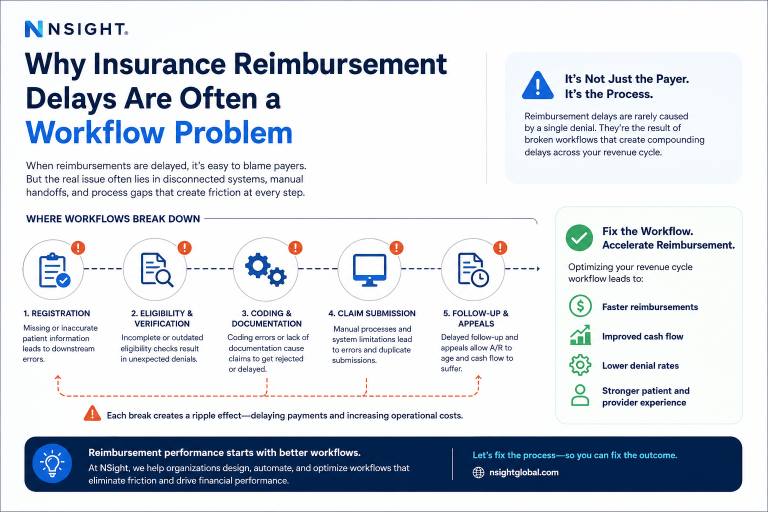
After reviewing thousands of billing cycles, we find that insurance reimbursement delays are rarely the result of a single, massive failure. Instead, they are usually a visibility problem.
A claim enters a “pended” or “in-review” status, but because the clinic lacks a structured tracking system, it sits in limbo for 45 days before anyone notices. These small, unmonitored gaps in the workflow cumulatively drag on your cash flow.
Resolving slow insurance payments for clinics requires moving away from reactive “check-ins” toward a diagnostic model that surfaces friction points in real time.
We will examine the specific operational delays in medical billing and how to build the visibility needed to move claims from submission to payment without the usual friction.
Segmenting Payer Timelines for Better AR Visibility
The first step in fixing a delay is knowing what “on time” actually looks like for each payer.
Most clinics view their accounts receivable (AR) as one large bucket, but treating every payer the same way creates a massive visibility gap.
Medicare typically processes clean electronic claims within 14 days. Many commercial payers, however, operate on a 30-day adjudication cycle.
If your billing team doesn’t follow up on a Medicare claim until day 45, you’ve already lost three weeks of potential cash flow. Conversely, calling a slow commercial payer at day 15 is a waste of administrative time.
By segmenting your AR by payer type, you can prioritize follow-up based on actual performance standards. This ensures that your team is not just “working the AR,” but is specifically targeting the claims that have deviated from their expected timeline.
Why “Clean Claims” Stall in the Adjudication Phase
Even when a claim is technically “clean,” it can still face insurance reimbursement delays due to administrative mismatches in medical billing.
These aren’t denials; they are pends that require manual intervention.
- Eligibility Variance: The patient’s coverage was active at the time of service, but they have since changed plans or added a secondary insurer.
- Coordination of Benefits (COB): The payer is waiting for the patient to confirm which insurance is primary.
- Credentialing Lag: A provider’s credentials haven’t been fully updated in the payer’s specific database for a new location or service.
These issues often go unflagged in standard billing software. The claim is accepted by the clearinghouse, but it sits “pended” on the payer portal.
Without a system that actively “scrapes” or monitors payer-specific statuses, these claims become the primary driver of slow insurance payments for clinics.
Eliminating the 30-Day Follow-Up Friction
In many practices, follow-up is treated as a secondary task. When the front desk is busy or the billing staff is handling authorizations, unpaid claims age.
We recommend a strict “30-Day Resolution” protocol. Every claim that reaches the 30-day mark without a payment or a clear denial must be touched.
After 60 days, the cost to collect that revenue increases significantly due to the labor required for research. By day 90, you are approaching timely filing limits that could result in a permanent loss of revenue.
Visibility means knowing exactly which claims are approaching these thresholds. A high-functioning billing department doesn’t wait for the monthly aging report; they work from a daily dashboard that surfaces claims the moment they cross into a “delayed” status.
Reducing Delays at the Point of Service
A significant portion of insurance reimbursement delays begins before the doctor even enters the exam room. If the front-desk workflow doesn’t include real-time eligibility (RTE) checks, the clinic is building rework into the system.
A patient may present an insurance card that is no longer active. If this isn’t caught at check-in, the claim will eventually be pended or rejected, causing a 30-to-60-day delay while the billing team tracks down the new insurance information.
Real-time verification ensures that the claim is submitted with the correct member ID and group number the first time, which is the most effective way to prevent slow insurance payments.
Tracking Denial Patterns to Prevent Future Stalls
When a claim is finally processed and denied, it’s a signal that your front-end process has a gap. The danger isn’t the single denial; it’s the pattern.
If a specific payer consistently denies a certain CPT code for “medical necessity,” it means your clinical documentation or your coding templates aren’t aligned with that payer’s current policy.
Simply fixing the individual claim and resubmitting it is a short-term fix. A long-term solution requires a “root cause analysis” to adjust the documentation or coding habits at the source. This prevents the next 50 claims from suffering the same delay.
Optimizing Workflow Through Targeted Automation
Automation should be used to provide visibility, not just to move data.
For a clinic dealing with insurance reimbursement delays, the most valuable automation tools are those that handle the “boring” parts of follow-up:
- Automated Status Retrieval: Systems that pull status updates from payer portals so your staff doesn’t have to log in manually.
- Intelligent Task Routing: Automatically assigning the “difficult” denials to your most experienced billers while routing simple corrections to junior staff.
- Predictive Scrubbing: Software that flags claims likely to be pended based on historical payer behavior for your specific specialty.
Diagnostic FAQ: Solving Payment Delays
1. Why does the payer status say “Accepted” but I haven’t been paid?
An “Accepted” status usually only means the claim passed the clearinghouse’s initial formatting check. It does not mean the payer has approved it for payment. The claim could still be “pended” for a manual review of medical necessity or a coordination of benefits (COB) check.
2. How can I tell if a delay is caused by my EHR or the payer?
Check your clearinghouse “rejection report.” If the error appears there within 24–48 hours of submission, it is likely an EHR setup or data entry error. If the claim is accepted but remains unpaid for 30+ days, the issue lies in the payer’s adjudication process or a clinical documentation gap.
3. What is the fastest way to resolve a “Coordination of Benefits” delay?
These delays often require the patient to contact their insurance company directly. The most effective way to handle this is to catch the potential COB issue during the front-desk eligibility check and ask the patient to resolve it before their appointment.
4. Should I resubmit a claim if it hasn’t been paid in 45 days?
No. Simply resubmitting the claim often results in a “duplicate claim” denial, which adds further delay. Instead, you must check the specific status and determine if a “corrected claim” or a formal appeal is required.
5. How do I know if my “Days in AR” is healthy?
While it varies by specialty, a healthy “Days in AR” is typically under 40 days. If your average is consistently above 50 or 60 days, it is a clear sign of systemic visibility gaps in your follow-up or front-desk workflows.
Strengthening Your Revenue Cycle Mechanics
Reducing reimbursement delays is a matter of tightening the mechanics of your office. It requires a shift from “waiting for checks” to “monitoring the process.”
When you have clear visibility into your AR segments, eligibility checks, and denial patterns, your revenue becomes much more predictable.
At Nsight Global, we specialize in the operational audit of your revenue cycle.
We don’t just “process claims”; we identify the specific visibility gaps and workflow friction that cause insurance reimbursement delays.
Our Revenue Cycle Management services are built on transparent reporting and aggressive AR follow-up to ensure your clinic receives every dollar it has earned.
If you are ready to move past the frustration of slow payments and want a clear assessment of your current AR performance, we can help.
Get in touch with Nsight Global today to discuss how we can help you build a more disciplined, transparent billing cycle.